NASA Social Media Audit
- Rene Schwartz
- Aug 4, 2020
- 11 min read
Updated: Jul 3, 2023


PURPOSE
The purpose of this social media audit and analysis is to determine how well NASA is performing in general on Facebook and Twitter, and in comparison, to its competitors, Lockheed Martin and Boeing. The value in conducting this analysis is to determine NASA’s overall brand community and voice, and its current presence on social media relative to Lockheed Martin and Boeing. Recommendations and areas of improvement for NASA’s social media presence will be provided at the end of this audit.
Founded in 1958, The National Aeronautics and Space Administration, or NASA, is a federal government agency focused on pioneering the future in space exploration, aeronautics research and scientific discovery.
Lockheed Martin is a global security and aerospace company focused on research, design, development, sustainability of advanced technology systems, products, and services. With operating units in aeronautics, missiles and fire control, rotary and mission systems, and space, Lockheed Martin’s goal is to advance scientific discovery and deliver groundbreaking solutions to their customers.
Boeing is a large aerospace company and leading manufacturer of commercial jetliners, space and security systems, and service provider. The company supports airlines and U.S. and allied customers in more than 150 companies and is America’s largest manufacturing exporter.
NASA’s public relations goal is to augment the public’s engagement with the company, and to contribute to the Nation’s science literacy. NASA's mission on social media is to allow users to explore the universe and discover Earth through their content. The company’s social media philosophy is to share content that is compelling to their audiences by showing how NASA is helping to solve the universe’s mysteries and make life better here on Earth.
METHOD
The following social media audit examines our client, NASA, and two of its competitors: Lockheed Martin and Boeing. NASA and its competitors were analyzed on Facebook and Twitter during the period of July 7, 2020 through July 21, 2020. Facebook metrics were pulled from BuzzSumo and Twitter data was taken from Keyhole.
For the conversation analysis, the key terms searched in mediatoolkit.com include: NASA, Boeing and Lockheed Martin. The context keyword used was space.
To figure out which posts of NASA on Facebook and Twitter were created vs. curated, a manual review of all posts on each platform was conducted and presented in the conclusion of this audit.
NASA (SOCIAL MEDIA OVERVIEW AND BRAND VOICE OBSERVATION)
Brand Voice Observation: NASA’s brand voice is scientific, as they constantly aim to provide their audiences with content that is compelling and informative. On both Facebook and Twitter, the NASA insignia is their profile picture and the cover photo on both platforms is the same (see Figure 1 and 2 below). The overall tone matches their brand voice in that their content is informative and scientific and provides users with the latest updates and information regarding NASA and scientific discovery and space research. When comparing brand voice across NASA and its competitors, overall tone for each company matches their brand voice.
LOCKHEED MARTIN (SOCIAL MEDIA OVERVIEW AND BRAND VOICE OBSERVATION)
Brand Voice Observation: Lockheed Martin's overall tone, or brand voice, is informative, prideful, and upbeat. The overall tone does match the brand voice, as most content shared is informative and upbeat. On Facebook and Twitter, the company logo is consistent on their profile picture. The cover photos (Twitter is a photo and Facebook is a short video) are different, but both portray Lockheed Martin’s capabilities to offer and deliver groundbreaking solutions in various industries such as aeronautics, missiles and fire control, mission systems, and space.
BOEING (SOCIAL MEDIA OVERVIEW AND BRAND VOICE OBSERVATION)
Brand Voice Observation: Boeing's main area of focus is science and space/air travel. The company also showcases innovative new products for those industries. Interestingly, there is a narrow difference between Boeing’s likes and followers on Facebook, and not in the way you’d expect. More people follow Boeing than “liked” it on Facebook. Meanwhile, on Twitter, the content posted appears to be different, yet both platforms use the same branded logo. While they are apparently catering to different audiences, the brand voice seems to consistently be informative and sometimes includes cool or interesting facts.
FACEBOOK TWO-WEEK ANALYSIS
The data below was collected from BuzzSumo and analyzed the Facebook accounts of NASA, Lockheed Martin, and Boeing during a two-week period: July 7,
NASA
2020 – July 21, 2020.
Total Posts: 70
Total Interactions: 1,015,946
Total Likes: 739,159
Total Comments: 31,203
Total Shares: 101, 952
Ratio of Comments to Likes: 1:23
For every 23 likes, 1 comment is posted. NASA, in comparison to its competitors, has a better ratio since it only takes about 23 likes to get one comment.
LOCKHEED MARTIN
Total Posts: 9
Total Interactions: 14, 584
Total Likes: 12,018
Total Comments: 254
Total Shares: 1,112
Ratio of Comments to Likes: 1:47
For almost every 47 likes, 1 comment is posted.
BOEING
Total Posts: 9
Total Interactions: 23,930
Total Likes: 18,454
Total Comments: 319
Total Shares: 3,033
Ratio of Comments to Likes: 1:57
For almost every 57 likes, 1 comment is posted.
FACEBOOK TWO-WEEK ANALYSIS (CONT.)
Figure 1 below depicts the number of daily Facebook posts for NASA (blue), Lockheed Martin (orange), and Boeing (gray) from July 7, 2020 – July 21, 2020. NASA is consistent and posts content on Facebook daily, whereas both Lockheed Martin and Boeing do not post daily. Both Lockheed Martin and Boeing went three consecutive days without posting (July 10 – 12, 2020). It appears that those days fall on the weekend, so NASA is posting on the weekend, whereas Boeing and Lockheed Martin typically do not.


According to BuzzSomo, the best days/time for NASA, Lockheed Martin, and Boeing to post on Facebook are depicted in Figure 2 below.


MOST LIKED POST ON FACEBOOK
NASA’S most-liked Facebook post between July 7 – 21 was shared on July 10, 2020 and received 58.5K likes, 17.5K reactions, 637 comments, and 9.8K shares. NASA shared content from NASA Sun Science, who highlighted NASA’s Parker Solar Probe.
Content related to astronomy and space activities, like spacewalks, receive the most attention on Facebook. For instance, the second most-liked post was a reminder for fans to join NASA on July 16 as they watch Astronauts Chris Cassidy and Bob Behnken venture outside the International Space Station for a spacewalk.
LOCKHEED MARTIN’S most-liked post was on July 17, 2020 and received 2.9K interactions: 2.3K likes, 70 comments, and 312 shares. The 30-second video showcased the design and sustainability of the F-35 aircraft and included a URL link to Lockheed Martin’s website for users to learn more about the aircraft.
Content related to their aircrafts, NASA spacecrafts (they help build), and the U.S. Navy or Air Force receive the most attention on Facebook.
BOEING’S most liked post was a video posted on July 16. It received more than 10,000 likes, 141 comments and more than 1,500 shares. This is a #TBT (Throwback Thursday) post referencing the Apollo 11 liftoff to the moon in 1969. The human voice behind this post was successful at playing off the emotions of the readers by referencing a historical moment in time and describing it in a very eloquent and descriptive way.
LEAST LIKED POST ON FACEBOOK
NASA’S least-liked post during the period of July 7 to July 21 was a live video from July 9 that received only 2,400 reactions, 70 comments and 125 shares. The content posted started with a question in an attempt to engage the reader/viewer. However, I have noticed that posts that start with questions do better on the Instagram platform and this being the least successful post during the time period would support that theory. It is, however, interesting that a live video of an astronaut answering real-time questions would do so poorly. Regardless of the not-so-engaging question at the beginning, it was written with a human and conversational voice.
LOCKHEED MARTIN’S least-liked Facebook post was about NASA’s InSight Mars lander and how it went from dusty to dust-free. NASA’s Jet Propulsion Laboratory and Lockheed Martin collaborate on the InSight mission which has been an innovator in Mars exploration for years. The post, which was published on July 17, 2020, received 359 likes, 6 comments, and 22 shares.
It’s interesting to note that a NASA-related post did the worst on Facebook. It appears that their posts with video or photos do better, so this post may not have performed well because it links to a rather dull-looking website.
BOEING’S least-liked post was a video posted on July 18. The post has 396 likes, 41 comments and 73 shares. It’s interesting that this post is the least successful, as its topic is air cleanliness amid a pandemic. One would think followers would be more interested in a video explaining how an air filter can trap more than 99.9% of airborne particles and possibly its ramifications in a grocery store or hospital environment. A shortened link was included in the post, which may have led to the lack of success and minimal engagement.
TWITTER TWO-WEEK ANALYSIS
The data below was collected from Keyhole and analyzed the Twitter accounts of NASA, Lockheed Martin, and Boeing during a two-week period: July 7, 2020 – July 21, 2020.
NASA
Total Posts: 201
Total Engagements: 916,048
Total Likes: 486,434
Total Retweets: 83,400
LOCKHEED MARTIN
Total Posts: 22
Total Engagements: 8,952
Total Likes: 3,321
Total Retweets: 874
BOEING
Total Posts: 12
Total Engagements: 1,703
Total Likes: 3,159
Total Retweets: 341
TWITTER TWO-WEEK ANALYSIS (CONT.)
Figure 3 below depicts the number of daily tweets for NASA (blue), Lockheed Martin (orange), and Boeing (gray) from July 7, 2020 – July 21, 2020. It is clear to see that NASA is consistent on social media and posts on a daily basis, whereas both Lockheed Martin and Boeing do not post every day. It’s interesting to note that Lockheed Martin went three consecutive days without posting on Twitter (July 10 – 12) and Boeing did not post on some days or after July 17.


According to TweetStats, optimal days/time for NASA, Lockheed Martin, and Boeing to post on Twitter are depicted in figure 4 below.


MOST LIKED TWEET
NASA’S most-liked tweet was at 7:15 p.m. on July 16, 2020, in which the post received 42,369 likes, 16,704 retweets, and over 1K comments. The tweet addressed rumors that NASA changed the zodiac signs and included a link to their website that provided users with more information on the math behind the astronomy. Many users engaged and interacted with this post because it answered and addressed rumors that the zodiac signs have changed, which caused a buzz on the internet.
LOCKHEED MARTIN’S most-liked tweet was at 2:10 p.m. on July 14, 2020. The post received 1,036 engagements: 801 likes, 235 retweets, and 40 comments. The tweet featured an infographic highlighting workforce readiness for the future of work. This post may have received a lot of attention considering the current COVID-19 situation and how Americans will eventually need to prepare to return to work in the future.
BOEING’S most-liked tweet was on July 13 with 445 likes and 114 retweets and comments. The post includes a first person-style inclusive statement on behalf of Boeing stating they are honored to have built such and such a plane for the United States Air Force. What is working for this post is the super cool GIF of what the plane looks like, and how the pilot looks in the cockpit. The aesthetics of this post is very nice.
LEAST LIKED TWEET
NASA’S least-liked tweet had only 567 likes and 57 retweets and comments and included a direct quote from NASA Director Michael Watkins about Mars Curiosity. What appears to be working against this tweet is it’s fairly new and doesn’t provide new or groundbreaking content. In other words, there’s no content creation here, but rather a quote from a prominent member of NASA. Typically, a post about Mars is extremely successful, as it is a mystery to humanity here on Earth, but perhaps the way this post was presented wasn’t hugely popular and/or didn’t stand out much more than other, better-crafted tweets.
LOCKHEED MARTIN’S least-liked tweet was a 15-second video about NASA’s Orion capsule. This tweet, however, was part of a series of replies to their original post about NASA’s Orion. This post on July 7 received 43 likes, 6 retweets, and 2 comments. This post may have received a lower number of likes/engagements because it was part of a series of replies, rather than an original, stand-alone tweet.
BOEING’S least-liked tweet was on July 17 at 11:00 a.m. with only 130 likes. The tweet was a survey asking Boeing’s audience what topic interests them the most about continuing to travel by air. According to the survey, Boeing’s audience is most interested in learning about new tech for safe travel. The short and sweet question and clear results make this post successful in a way other than likes, in that there were 2,474 voters in the survey alone. However, surveys don’t seem to garner very many likes in themselves.
CONVERSATION ANALYSIS
A conversation analysis was conducted to evaluate conversations about NASA and its competitors, Lockheed Martin and Boeing, on Facebook and Twitter and outside their social media sites. The following data was collected from mediatoolkits.com during the period of July 7, 2020 – July 21, 2020.
TOTAL MENTIONS OVER TIME AND PER CHANNEL
Using mediatoolkits.com, the terms NASA, Boeing, and Lockheed Martin were used as keywords and cross referenced with the context “space.” In general, NASA topped its competitors in online mentions during the two-week period.
Figure 5 below shows total mentions over time for NASA, Lockheed Martin, and Boeing. In total, NASA had 682 mentions, followed by Lockheed Martin at 294, and Boeing with 250 mentions. Figure 6 below breaks down mentions by channel and shows that NASA topped its competition on Facebook, but Boeing surpassed NASA and Lockheed with total mentions on Twitter.


SHARE OF VOICE VS SHARE OF IMPRESSIONS
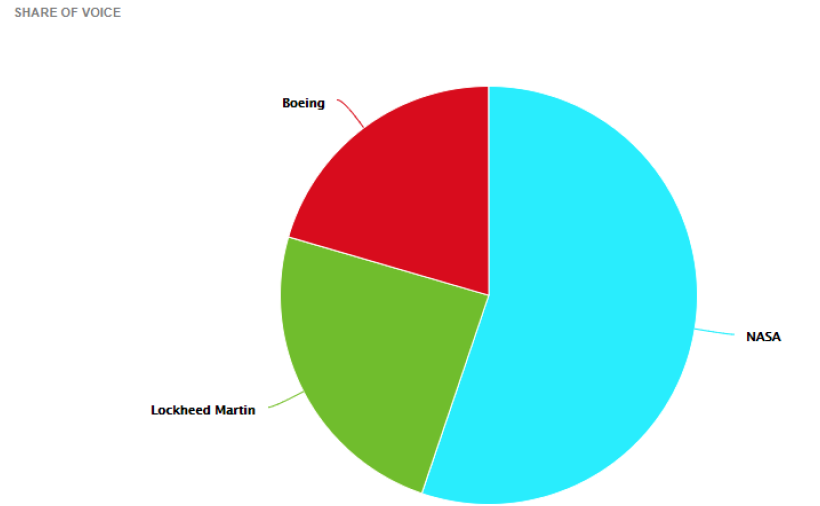
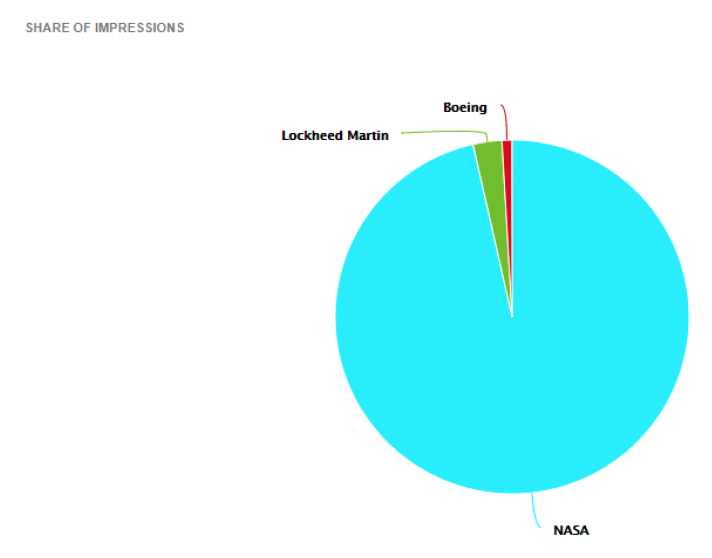
When analyzing share of voice, NASA has 55.2% share of voice followed by Lockheed Martin at 24.3% and Boeing with 20.5%. NASA also dominated in terms of share of impressions with 96.5% followed by Lockheed at 2.6% and Boeing with less than 1%.
When comparing share of voice (figure 7) to share of impressions (figure 8), this tells us that NASA can talk less and still reach more audiences. Therefore, their focus should be on quality of posts rather than quantity of posts.


NUMBER OF MENTIONS PER SENTIMENT
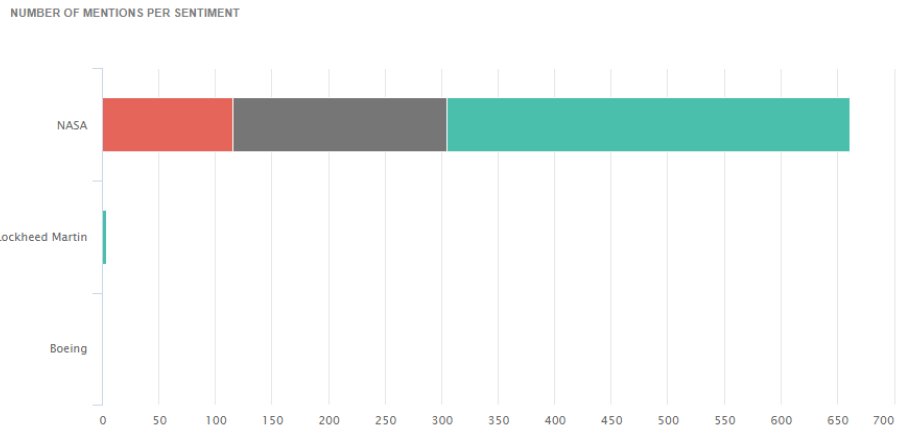
As seen in figure 11, NASA’s share of sentiment appears to be mostly positive with 356 positive mentions, followed by neutral at 190, and lastly negative at 115 mentions. Lockheed Martin has four total mentions and they are all positive.
There is not enough data during July 7 – July 21 for Boeing to extract any numbers or information for this sentiment analysis. At the beginning of the audit, we had anticipated “space” would have been a much bigger topic on Lockheed Martin and Boeing’s social media accounts. We were surprised to learn that, perhaps, they are not the competitors to NASA we thought they were.
Due to having more data, it makes sense NASA would have a large amount of negative mentions. However, the important thing is the positives are more than double what the negatives are.

CONVERSATIONS OUTSIDE SOCIAL MEDIA PLATFORMS & INFLUENCER ANALYSIS
When evaluating conversations outside NASA’s owned media on mediatoolkit.com, a lot of the results are in other languages, such as Russian, Spanish, Serbian, Italian, Portuguese, and many more. From our findings, NASA is an international topic and is talked about all over the globe.
Several posts are in English and talk about what NASA’s building and the excitement surrounding launches and NASA as a space exploration agency (see figure 10 below). Some conversations surrounded NASA’s upcoming rover launch to Mars. These posts run the gamut of positive, neutral, and negative sentiment.


In terms of influencers, figure 11 showcases NASA, Lockheed Martin, and Boeing’s top 10 influencers on social media. Top influencers for all three appear to be solely news sources such as CNN, Forbes, and CBS News.


CONCLUSION AND RECOMMENDATIONS
After conducting a social media audit of NASA’s Facebook and Twitter accounts during July 7, 2020 – July 21, 2020, we found that NASA is successful at engaging its audience on social media, and their overall tone on social media matches their brand voice in that their content is tailored to the platform and provides users with the latest NASA updates and facts. Most of NASA’s content on both Twitter and, to a greater extent, Facebook, is created, while the rest is curated. Out of a total of 70 Facebook posts, roughly 65 were created and 5 were curated. Out of a total of 201 Twitter posts, roughly 165 were created and 36 were curated.
In comparison to its competitors, NASA is successful at consistently posting on both platforms. NASA posts at least three times daily on Facebook, and at least twice daily on Twitter. NASA’s “least liked” content on both platforms also performed better than its competitors’ most liked content in terms of likes and reactions. While NASA has some negative sentiment on its space-themed content, it has more neutral and more than double the positive sentiment.
Moving forward, we recommend NASA:
• Continue posting daily and on weekends, as this puts them at an advantage compared to their competitors who do not post daily or on weekends
• Continue to engage audiences with creative hashtags, as NASA’s competitors surprisingly lack in that department, and generally do not include hashtags in their social media posts
• Investigate as to why there is negative sentiment and develop a plan for responding to those comments
• Post important content during optimal times to gain more interactions and engagements: Wednesdays at 12:00 p.m. on Twitter and Thursdays at 7:00 a.m. on Facebook
• Focus on quality of content and not so much on quantity, as NASA is able to talk less and still reach more audiences


Comments