Shortcuts and their sociolinguistic uses and effects in text messaging
Updated: May 17, 2021
Rene M. Schwartz
Nov. 29, 2017
Abstract
Shortcuts in text messaging, though an understudied aspect of communication, are critical to the understanding of the sociolinguistics of texting. This study aims to show that shortcuts make texting easier for the participants by analyzing a selection of text messaging interactions between two participants. In doing the analysis, the researcher proved that shortcuts serve two purposes. First, shortcuts in writing, such as acronyms or “text speak” make getting your message across take less time. Second, shortcuts can convey more meaning in fewer words (using abbreviations), the same amount of words (capitalizing the entire word or message) or no words (with emojis or emoticons). These findings signify that the process of text messaging, and the sociolinguistics of writing in general, have become and will continue to be more evolved from abbreviations to emoticons and to emojis and beyond. More importantly, the findings indicate that shortcuts expedite effective communication.
Keywords: sociolinguistics, text messaging, emojis, ellipses, emoticons, shortcuts, filled pause, context, heteroglossia, textspeak, colloquial speech
Shortcuts and their sociolinguistic uses and effects in text messaging
Sociolinguistics has primarily been studied through spoken language; however, the meaning of sociolinguistics should cover all societal language, including writing, as a complete social science. In an effort to assist with this endeavor, the researcher has studied a narrow aspect of the text messaging experience: shortcuts.
Method
No one has discussed text messaging shortcuts and how they can save time and/or simplify texting conversation for the participants involved. Narrowing the focus, through the research it has been discovered that not much has been found thus far on the use of shortcuts and how they change meaning within written conversation. Some of the research has already been done on the sociolinguistics of writing (Lillis, 2013) but leaves a gap that this paper intends to fill.
It is the researcher’s theory that shortcuts can do two main things for the participants of a text message exchange: 1) A user of shortcuts can type messages faster by using automatic text replacement; and 2) A user of shortcuts can convey more meaning in fewer words by using abbreviations, the same amount of words by capitalizing certain words for emphasis or no words with emojis or emoticons. The following authors' articles were the basis of the research and the researcher has briefly summarized their findings.
Caroline Tagg (2016) contributed to the current understanding of social interactions within sociolinguistics by using Mikhail Bakhtin's theory of heteroglossia (1981). Tagg explores through text message interactions how heteroglossia, defined by dictionary.com as “the presence of two or more voices or expressed viewpoints in a text or other artistic work” (n.d.), can emerge even in interactions between individuals with similar backgrounds and language resources.
Dixon (2011) found that many people were using abbreviations long before the social media platform Twitter and that the shortcuts helped to get your point across with the 140-character limit. The article goes on to list some of the common, less common and downright esoteric examples of internet shortcuts used up to and during 2011 (when the article was written). One of these examples Dixon gives is to type simply the number “9” to indicate that there is a parent watching. When that child types “99” it means the parent is no longer watching. It can be assumed from this that the two texters are being incognito and hiding their secret shortcuts from bystanders. Even if the bystanders saw the conversation, they probably wouldn’t know the significance of the shortcuts.
In an article about sarcasm in written communication, the authors investigate the use of emoticons in clarifying message intent. The article shows how some people can use shortcuts to convey sarcasm or criticism with pictures, emoticons or ellipses (Thompson & Filik, 2016). This adds another layer of sociolinguistics to texting because many people may not know the intent behind a contextless sentence made up of just letters and words. When you use an emoji or emoticon, the other participant is given extra information and more meaning is conveyed in the text.
In an article by Monica A. Riordan (2017), she discusses using pictures in texting and explores how emojis and emoticons are used as a shortcut to convey affect in written conversations, rather than communicating emotions face-to-face. Riordan also suggests that, perhaps, the time and effort involved in using emojis may be counterintuitive to the use of shortcuts because the extra time and care an individual takes to pick out the image, as well as the time it takes to try to interpret the meaning behind the symbolic gesture, may lead to helping to maintain and enhance the social relationship between the participants.
A term coined by Richard Dawkins in his 1976 book, “meme” was the word he used to attempt to explain the way cultural information spreads. According to Douglas Downing’s Business Dictionary (2013), a meme is an image that spreads quickly from person to person. More specifically, a meme is a visual or textual joke or recurring gag usually transmitted through social media and shared widely to many people who keep the joke going. Like poetry, memes lose their thrust when paraphrased or translated literally word for word. Memes get meaning not from individual words, but from the way words (and images, fonts, sound, music) are put together (Rymes, n.d.).
In this study, the researcher uses the above resources to explore the role that shortcuts play in the sociolinguistics of writing. Additionally, the researcher does this by extrapolating on parts of several theories to come up with her own conclusions. Some of the theories the researcher will employ are Bakhtin's heteroglossia, Dell Hymes' S.P.E.A.K.I.N.G. model and politeness theory. This paper seeks to fill a gap in the literature regarding shortcuts in texting and the researcher will do this using her own transcripted interactions (screenshots) as examples.
Participants
The participants involved in the data of this study were the researcher and Joseph Hurst, or Joey. Joey is a 37-year-old Caucasian male who is the researcher’s boyfriend. They live together in a low-rent apartment in a nice area of Galveston. It is also relevant they work at the same place, The Galveston County Daily News. However, they have different jobs and work slightly different shifts. The researcher selected the conversations between Joey and herself to analyze because she texted with him the most and had the most examples of data to choose from and use in the study.
Situation
The situation of most of these text message interactions took place in the afternoon or evening while the researcher was at work and while Joey is at home. There were exceptions to this in which either Joey was also at work or the researcher was at home. Oftentimes, the psychological setting of the situation while the researcher was at work and Joey was at home, is he believed that the time apart should be designated as his alone time, so as to entertain himself by reading. If the researcher texted him while he was engaging in reading, oftentimes he got easily frustrated with being interrupted and had little patience for the conversational floor she established or topic she proposed.
Ends
The goal for the conversations varies greatly from text to text. Sometimes the goal is for one or both of the participants to feel as though they’re maintaining communication throughout the day, and for this reason the researcher often initiates the conversation. Sometimes the goal is to make Joey laugh or, in the cases of puns and memes, to make Joey roll his eyes. Other times, the goal is just to remind Joey to do something for later. Other people may scribble down things they want to remember; instead of this, sometimes the researcher texts Joey.
Key
The tone is almost always playful. Joey and the researcher clearly have a close, equal relationship according to the dimensions of power and solidarity (Tannen, 1993), and mostly employ colloquial speech while only using slang ironically. Alternatively, the two participants sometimes have the occasional fight completely by text message. Sometimes fights are started through text messages. Most of the time the participants spend texting is spent in good spirits with good intentions.
Instrumentality
In most of the examples, it could be hard to tell where Joey is from. When talking to each other, Joey and the researcher commonly speak in a casual register; the participants rarely speak in a careful, grammatically standard form, though it does happen occasionally.
Norms
Regarding the norms of communication and the rules guiding the texts, the biggest rule, though unspoken, is that the participants stay respectful to each other. Sometimes, if in an argument, one of them will break the rule and say something that is regretted. In Extract 5, the researcher did, at one point in one of the conversations, tell Joey not to curse at her again. That is a boundary she set up in the ever-changing dynamic of text messaging conversation. Most of the time, however, the conversation is civil and respectful.
Genre
The genre changes in each and every text messaging interaction and sometimes several genres exist in a single conversation.
Materials
In the study, the researcher analyzed a large section of at least 100 text messages on her iPhone 7 between Joey and herself. The time frame of the text messages ranged from noon to 2 a.m. The data being analyzed came from text messages on the researcher’s cellphone with full permissions from Joey, and was transferred to the researcher’s computer via the screenshot feature and then emailed to her. None of the messages that appear here have been altered. The selection process asked two questions: were there any shortcuts used and can those shortcuts be interpreted and understood by an audience outside of the participants.
Results
Extract 1
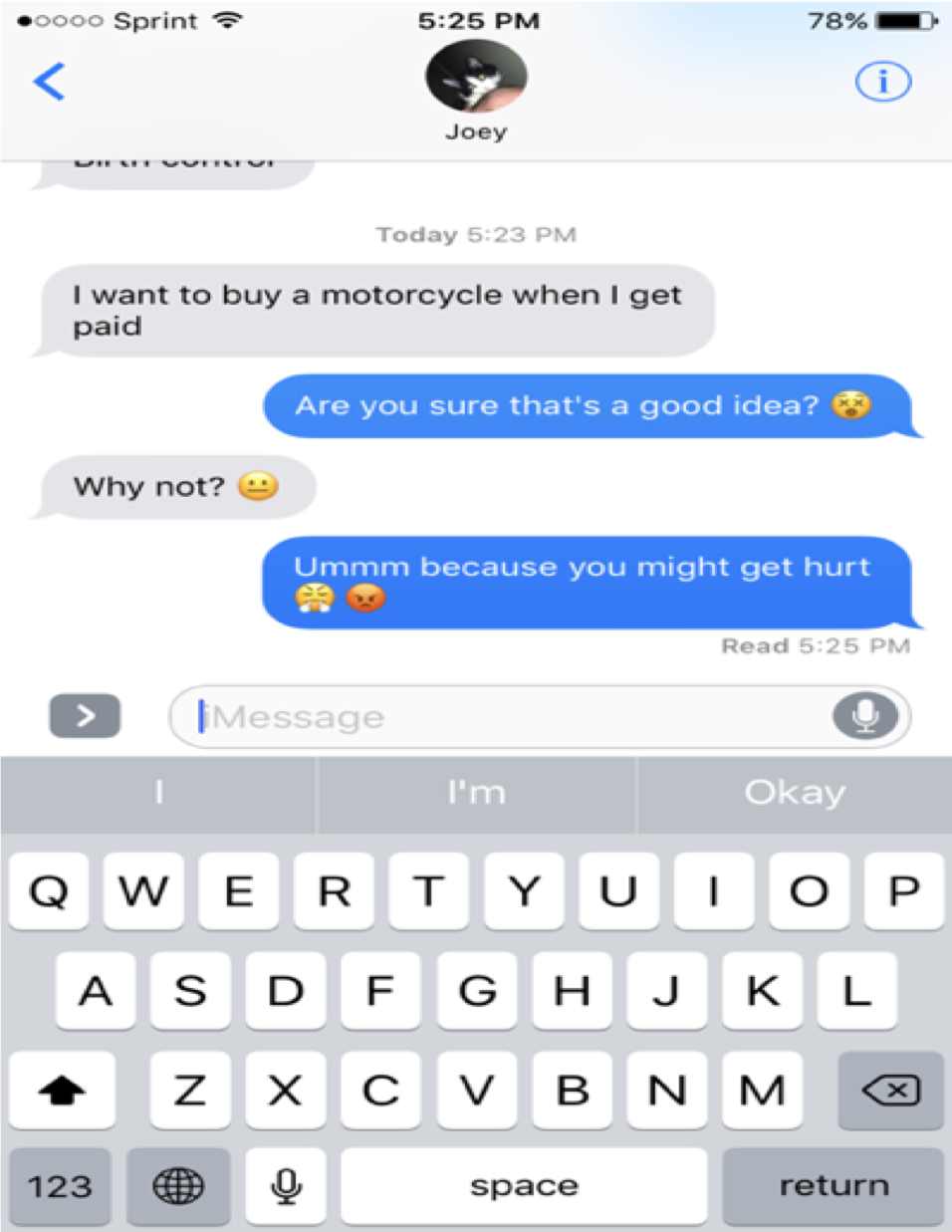
The conversation in this screenshot is short and sweet. Joey initiates a conversation with the researcher by texting her he wants to buy a motorcycle when he gets paid. The researcher responds by questioning if that was a good idea and uses an emoji with Xs over the eyes and a wide-open mouth, which could indicate a dead person. Joey responds by asking why it wouldn’t be a good idea and uses an emoji with an expressionless face (the mouth is neither smiling nor frowning) which could indicate indifference in response to the dead person emoji. In response to this, the researcher replies with a variation on the filler word “um,” also known as a filled pause; and follows with “because you might get hurt” and ends the conversation with two emojis that suggest aggravation.
In this interaction, an observer of just the text of the messages might not understand that the researcher is getting upset with Joey. Said observer might think that without the semiotic cues or shortcuts, otherwise called emojis, the researcher was genuinely curious about what Joey thought about the idea instead of gravely warning Joey he could get hurt. Additionally, though the “um” is stretched out, one could argue this is another example of a shortcut as if the researcher is trying to begin the response by stating that what follows should be obvious to Joey. Additionally, it could be argued that the exaggerated “um” was used in place of “duh” (Kelley, 2008, p. 2), and which can be assumed to insinuate the researcher is not happy with Joey’s intention to buy a motorcycle. This is further proved by the angry, aggravated emojis.
Extract 2

In this text messaging interaction, the researcher instigates the exchange and enters the conversational floor by sending a meme. This particular meme happens to be a pun. Joey responds with three emojis, all of which seem like they are annoyed. He even sent the emoji with the Xs over the eyes and the mouth wide-open, the dead person emoji, indicating the researcher is “killing him” by subjecting him to the pun. No words are used except in the meme but, as in pragmatics, more was communicated than was said by using the emojis (Yule, 1996).
Some people dismiss puns as the lowest form of humor (Pollack, 2011) and Joey is one of these people. The first emoji, similar to the one seen in Extract 1, shows a face with no mouth expression and the eyes look closed. The following emojis each can be explained using politeness theory (Brown & Levinson, 1987). Joey is using negative face in an attempt to essentially convey he doesn’t want to be bothered with any more puns. The first emoji simply conveys annoyance.
The second emoji has its teeth bared, eyes open and looks relatively anxious, possibly also indicating annoyance with the pun. It also possibly could convey feigned annoyance. The third emoji, which also appeared in Extract 1, conveys the same meaning. It’s as if he’s saying he’s dying from being subjected to so much annoyance. Without using any words whatsoever, the researcher and Joey had a successful, easy to understand, multimodal text messaging conversation.
Extract 3


This is a comprehensive list of all 48 keyboard shortcuts the researcher has as well a screenshot of what it looks like when one of those shortcuts is automatically applied in conversation. As one can see, the time and energy that has gone into adding each of these shortcuts is significant. Extrapolating from what Riordan (2017) found about using emojis to maintain and enhance social relationships, the researcher argues that text replacement does the same for evolved, intimate, colloquial speech (Trask, 1998, p. 27). In the seventh screenshot, the researcher typed in “gonna” which is a shortcut for the words “going to,” and it shows the automatic text replacement.
This long list of 48 keyboard shortcuts came about from a long time of using textspeak and growing and maturing into wanting to sound more professional. Using the keyboard shortcut feature, the texter can continue typing casual, imperfect English and the other participant would never know because it gets autocorrected to clear, proper English by the researcher’s own prompting. This also helps the researcher maintain her face as a writer. The sender spends a significant amount of time and puts in effort to managing her appearance “online,” the product of participation fetishism (Bobbitt, 2009), the philosophy that people spend a lot of time keeping up with their online persona. This gives the appearance that the texter or, in this case, the researcher is taking extra time to show the recipient, or, in this case Joey, that they are worth proper, appropriate, but not so far as it becomes overly professional, language; this is in contrast to those who use lazy shortcuts in words for example “where r u,” or “i have sumthin 4 u.” The effort of comfortable conversation conveys polite, positive face.
In addition to the keyboard shortcuts, another point worthy of analysis is the use of emojis in the seventh screenshot. The locutionary act is, “One of us is going to have to get gas”; the illocutionary act is the researcher is asking that Joey get gas; and the perlocutionary act is a regretful eye roll emoji, but it is indicated and understood he is going to get the gas. (After the messages were exchanged and Joey got off work at 2:30 a.m., he filled up the car with gas on his way home.) If he were not going to get the gas or, for instance, use his available deniability since he was not specifically asked to put gas in the car, he might have indicated that some other way. The researcher responded with the angel emoji to indicate she appreciates the unenthusiastic acceptance of the requested task at hand.
Extract 4


Joey initiates a conversation about some DVDs he ordered that he needs to return. He also says he found the correct DVDs intended as a gift for the researcher. She replies with “really” but with exclamation points and question marks behind it. The researcher continues the conversation suggesting Joey go to either The UPS Store or the post office to send them back. The conversational flow then transitions into the researcher telling Joey she needs to take her mom to the airport and asking if, after she drops off her mom’s car, he could pick her up. He responds sarcastically by fake apologizing and suggesting the researcher walk home. To further demonstrate the fact that he’s just playing around, Joey sends a winking emoji that’s sticking its tongue out. In response to his joke, the researcher simply says “cute.” This, it could be argued using politeness theory, is negative face in that the researcher is saying that it’s cute but the rest of the context indicates that she’s being sarcastic. This is similar to Joey’s response to puns. He is obviously annoyed but not in a confrontational way, more in a playful way. This is further supported by Joey using the researcher’s word of exasperation to compliment the researcher. The researcher ends the conversation with an ambiguous emoji that could be construed as her saying, “oh, shut your mouth,” or “zip your lips.” But, the meaning is explained with the researcher’s final text: she is speechless in response to the compliment. This is probably because she’s annoyed with his joke, which, again, is similar to Joey’s reaction to the researcher sending him puns (see Extract 2).
Extract 5


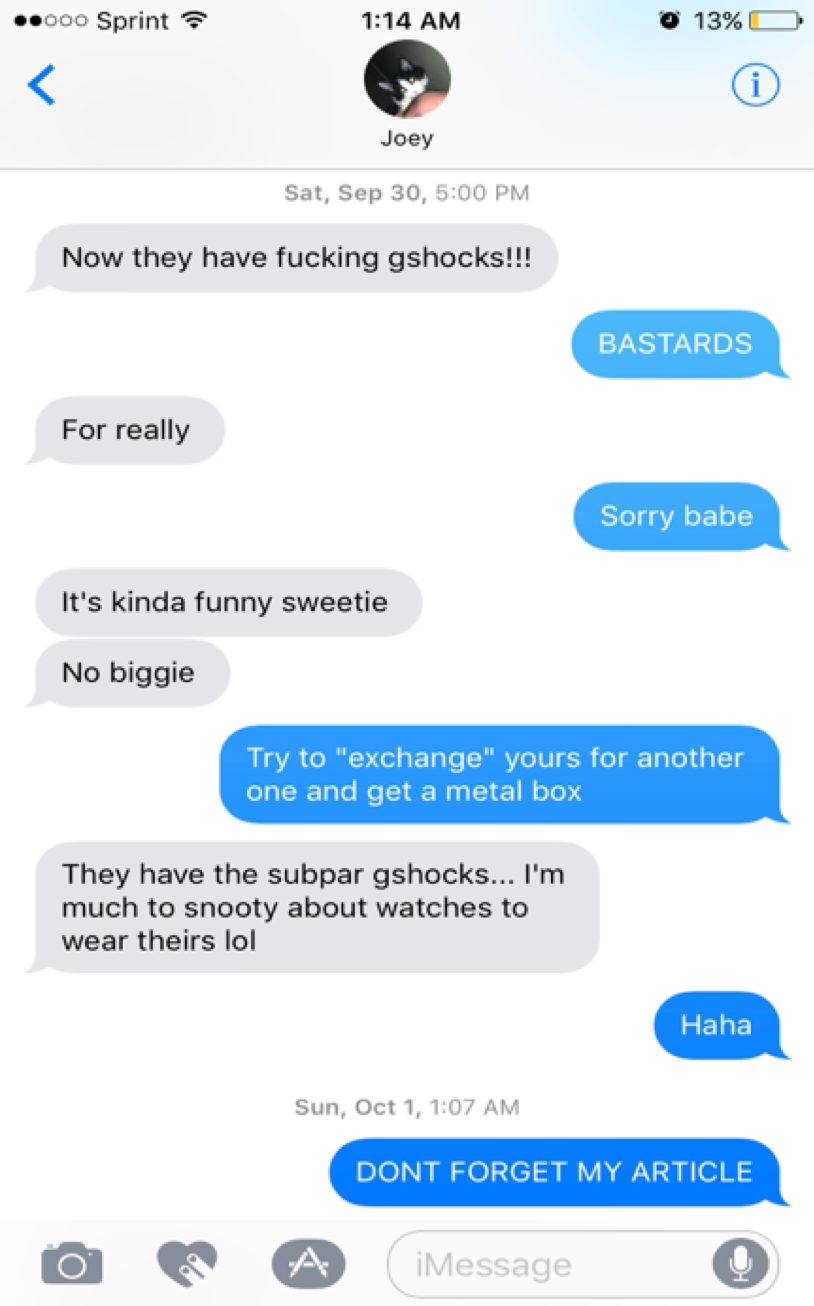

In this conversation, the relevant data that is going to be looked at is a norm/rule breach, some dark humor, use of all uppercase words, another pun and an emoji. Joey initiates the conversational floor by claiming strawberries are fine to eat on the diet in which he and the researcher are partaking. She responds by disagreeing with him. Instead of calmly sending his next text, he decides to breach the unspoken rule they have when communicating with each other and not only say “no” to her, but “fuck no.” To which she responds by intending to communicate with Joey that his text was unacceptable and with straightforward “Don’t cuss at me.”
After the conversation transitions to the topic of eating bread or other carbs, Joey sarcastically texts he would murder children for a donut. Because Joey had cussed at the researcher earlier, she didn’t play along and joke back. Instead she flatly responded, with a serious response, “don’t do that.” Picking up on the vibe of the researcher, Joey flatly responded back that he wasn’t actually going to do it. Perhaps the action that would have kept this conversation in the joking realm could be if the researcher sent an emoji like the crying laughing emoji. If she had, Joey might have kept up the tone. Without that emoji as a shortcut, it would take a lot more effort from the participants to save face after a situation like this.
A few times during the course of the day of which this conversation spanned, the researcher reminded Joey to bring home her article that she left at work. One of these times she sent the reminder in all uppercase letters. This is a shortcut for conveying importance which is similar to bolding or italicizing on a word document, but fonts and design elements aren’t very customizable through cellphone text messaging except to uppercase certain words. Some phones may have a few other limited means of customizing the text appearance but the researcher’s iPhone did not. A case could be made that sending the same reminder multiple times is more or less effective than sending the reminder once in all capital letters.
Instead of responding to the researcher’s reminder not to forget to bring her the article, Joey sends the researcher a pun she had sent him earlier that hadn’t been resolved yet. This could indicate either he got the reminder and it was unnecessary or he was indicating that he was ignoring the tone of the all capital letters. And just like in Extract 3, Joey expressed displeasure at being sent the pun.
Discussion
While sociolinguistics has primarily been the study of spoken language, through this article the researcher has used current theories and models to analyze a written form of language — the text message. The data collected from this small study suggests that the researcher’s theory was correct in that shortcuts both help a user send messages faster and they can convey more meaning in fewer words or no words. By analyzing my own text messages using heteroglossia, the S.P.E.A.K.I.N.G. model and politeness theory, the researcher proved that shortcuts expedite effective communication.
A potential gap in this study is establishing a defined “most effective” shortcut. An idea for additional study is to test what is more effective in reminding the recipient of something: sending the same message over and over again or sending it once but setting it apart from the rest of the thread of messages by capitalizing all the letters.
Another potential gap in this study is how the heteroglossia of text messaging shortcuts differ between other hierarchical relationships. For instance, are shortcuts as common between siblings as they are between an employee and her boss?
Keeping the potential gaps in mind, this study could easily be replicated using a different hierarchical relationship to analyze the use and effectiveness of shortcuts. Further research of the sociolinguistics of text messaging shortcuts might benefit from a larger sample size; however, in this study, I believe that the sample size of 100 different text messages was representative of most of the communication between Joey and the researcher, though it might not be for other hierarchical relationships.
References
Bakhtin, Mikhail. (1981). The dialogic imagination (transl. Caryl Emerson and Michael
Holquist). Austin, Texas: University of Texas Press.
Bobbitt, R. (2009). Decisions, decisions: Case studies and discussions in communication ethics.
Dubuque, IA: Kendall Hunt.
Dixon Jr., H. B. (2011). Texting, tweeting, and other internet abbreviations. Judges’ Journal,
50(4), 30-33. Retrieved Oct. 1, 2017.
Heteroglossia. (n.d.). Dictionary.com's 21st Century Lexicon. Retrieved November 5, 2017 from
Dictionary.com website http://www.dictionary.com/browse/heteroglossia
Hymes, D. (1974). Foundations of Sociolinguistics: An Ethnographic Approach. Philadelphia: U
of Pennsylvania Press.
Kelley, D. L. (2008). Doing meaningful research: from no duh to aha! (a personal record).
Journal of Family Communication, (1), 1-18. doi:10.1080/15267430701573573
Lillis, T. M. (2013). The Sociolinguistics of Writing. Edinburgh University Press.
Meme. (2013). D. Downing, Barron's business guides: Dictionary of computer and internet
terms (11th ed.). Hauppauge, NY: Barron's Educational Series.
Pollack, J. (2011). The pun also rises: How the humble pun revolutionized language, changed
history, and made wordplay more than some antics. New York: Gotham Books.
Rymes, B. (n.d.). Posts about memes on citizen sociolinguistics. Retrieved Oct. 31, 2017, from
Riordan, M. A. (2017). Emojis as tools for emotion work: communicating affect in text messages.
Journal of Language and Social Psychology, 36(5), 549-567. Retrieved Oct. 1, 2017.
Tagg, C. (2016). Heteroglossia in text‐messaging: Performing identity and negotiating
relationships in a digital space. Journal of Sociolinguistics, 20(1), 59-85. doi:10.1111/josl.12170
Tannen, D., (1993). The relativity of linguistic strategies: Rethinking power and solidarity in
gender and dominance. Gender and Conversational Interaction, ed. 165-188. Oxford
University Press.
Thompson, D., & Filik, R. (2016). Sarcasm in written communication: emoticons are efficient
markers of intention. Journal of Computer-Mediated Communication, 21(2), 105-120.
Trask, R. L. (1998). Key Concepts in Language and Linguistics (Key Concepts Series).
Routledge. 275 pages.

Comments